
1. Home
  2. Immunology

Basic immunology

Interactive animations: the molecular interactions between antigen and antibody, and a virtual laboratory of India-ink injections and dissections to study the lymphoid organs of the mouse.

EnglishDrag and dropHTML5, no plugins
“We live in a potentially hostile world filled with a bewildering array of infectious agents of diverse shape, size, composition and subversive character which would very happily use us as rich sanctuaries for propagating their ‘selfish genes’ had we not also developed a series of defense mechanisms at least their equal in effectiveness and ingenuity. It is these defense mechanisms which can establish a state of immunity against infection (Latin immunitas, freedom from) and whose operation provides the basis for the delightful subject called ‘immunology’.” Ivan M. Roitt, 2013. Essential Immunology.
1

Antigen–antibody interactions

Explore the hydrogen, hydrophobic, electrostatic and van der Waals bonds that hold antigen and antibody together.

Antigen–antibody interactions
New tab
Press play, then click each bond type to zoom into the molecular interaction. The info button shows the schematic representation of the immunoglobulin. On iOS devices full screen may not work; use “New tab” instead.
Learn more

Antigens

Antigen is any substance able to bind specifically to an antibody or T-cell receptor. However, not every antigen is able to stimulate an immune response. When it does, we call it an immunogen.

Immunogen is a molecule capable of inducing a specific immune response. Therefore, every immunogen is an antigen, but not every antigen is an immunogen — as is the case with haptens, small molecules that become immunogenic when conjugated to a specific carrier.

Epitope is a small part of the antigen's molecular structure that is recognised by an antibody.

Antibodies

Antibodies are glycoprotein molecules produced by plasma cells in response to an immunogen. They bind specifically to a part of the antigen known as the antigenic determinant or epitope.

All immunoglobulins have a four-chain structure as their basic unit: two identical light chains (around 23 kDa) and two identical heavy chains (50–70 kDa) held together by disulfide bonds. Three-dimensional images show that the molecule is not straight as represented in the animation: the hinge region is its flexibility site. It also presents an invariant fragment (Fc) and Fab fragments, which contain the antigen-binding site.

The five classes (isotypes)

Based on differences in the amino-acid sequences of the heavy-chain constant region, immunoglobulins are divided into five classes:

  1. IgA — secreted on mucosal surfaces for defence; present in breast milk.
  2. IgD — works primarily as an antigen receptor on B cells and acts as an Ag receptor on naïve B lymphocytes.
  3. IgE — involved in allergic and inflammatory responses.
  4. IgG — opsonisation; activation of the complement system (inflammation and phagocytosis); antibody-dependent cell-mediated cytotoxicity; feedback inhibition of B cells. The only isotype that crosses the placental barrier.
  5. IgM — expressed on the surface of naïve B cells. Eliminates pathogens in the early stages of B-cell mediated immunity, before there is enough IgG, by activating the complement system.

“Antigen–antibody interactions” by Luiz Anastácio Alves, Thais Faggioni, Filipe Faria Berçot and Rodrigo Bisaggio is licensed under Creative Commons BY-NC-SA 4.0.

2

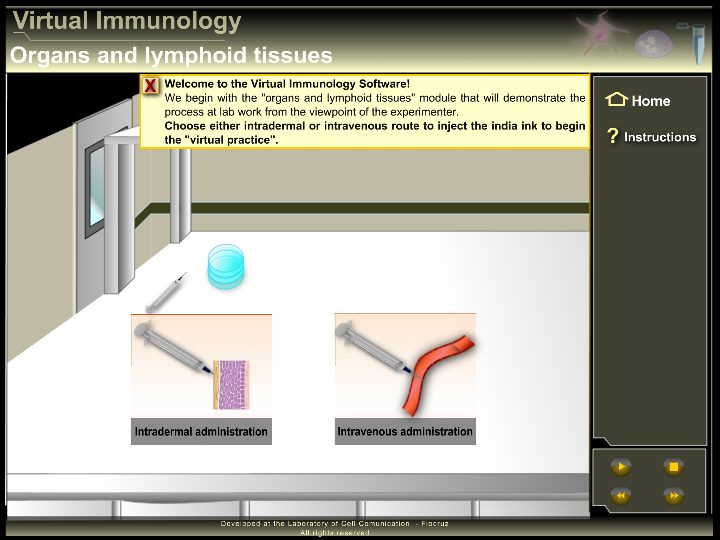
Lymphoid organs: virtual practices

Drag-and-drop simulations of India-ink injections and dissections in the mouse.

Complete path: lymphoid organs

Everything in a single player, without switching tabs: choose the route and follow the virtual practice and the dissection — intradermal (footpad injection → popliteal lymph node) or intravenous (tail-vein injection → lymphoid organs).

Recommended
The acute inflammatory response module (seven animations) and the concepts of lymphoid organs are currently available in Portuguese only.